
Housebreaking Case Study
Housebreaking a dog can be difficult for a number of reasons. Anxiety, ineffective training, and lack of a schedule can all contribute to his/her failure to house train. But there is hope, and that hope lies in Raise the Bar Dog Training.
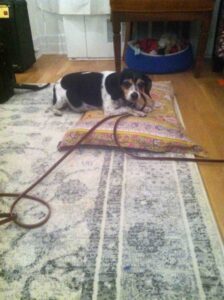 I recently worked with an owner who was finding it impossible to housebreak her new dog, Wynona. Wynona was about a year old when her owner called, and her problem stemmed from anxiety and inconsistency.
During the in-home consultation, I noticed it was very difficult for the owner to get Wynona outside at all, let alone convince her to eliminate. Simple things like car noises and other animals would send her running with her tail between her legs. I quickly realized this wasn’t simply an issue of housebreaking Wynona, but of walking her, tossing a ball with her…essentially giving her an active, fulfilling life and letting her owner share that life with her.
We began the training with focus exercises, which taught Wynona to look to her owner for cues, rather than to her surroundings or herself. We did this through a combination of basic obedience training, crate training, and proper leash-handling techniques. We also put Wynona on a strict schedule—eating, drinking, and outside time were all regulated by the owner. This set Wynona’s focus even more strictly on her owner and away from herself.
Dogs require this kind of structure and “short leash” approach because it’s what is given to them in the wild, and it’s what they respond to at their most basic, instinctive level. In the wild, there is a pack, and there is always a leader, or Alpha, of that pack. The owner’s job is to step up to the plate and lead the pack.
With the schedule enforced and the focus training begun, Wynona began noticing fewer outside stimuli and stopped feeling responsible for everything and everyone within the household. She realized she was being taken outside only at certain times, and after being taught she to ignore the distractions that had previously scared her, she learned the routine, what was expected of her, and began eliminating outside of the house.
Don’t believe it when you’re told your dog has a small bladder and you’ll simply have to live with it. In my time as a dog trainer, I have never seen an instance where that was the case. Dogs are designed to hold their bladders for a longer period of time than people, and with proper training, they can be taught to follow a schedule and urinate only in designated places.
Give me a call at 800.649.7297 to see exactly how we can help you achieve the same results.